
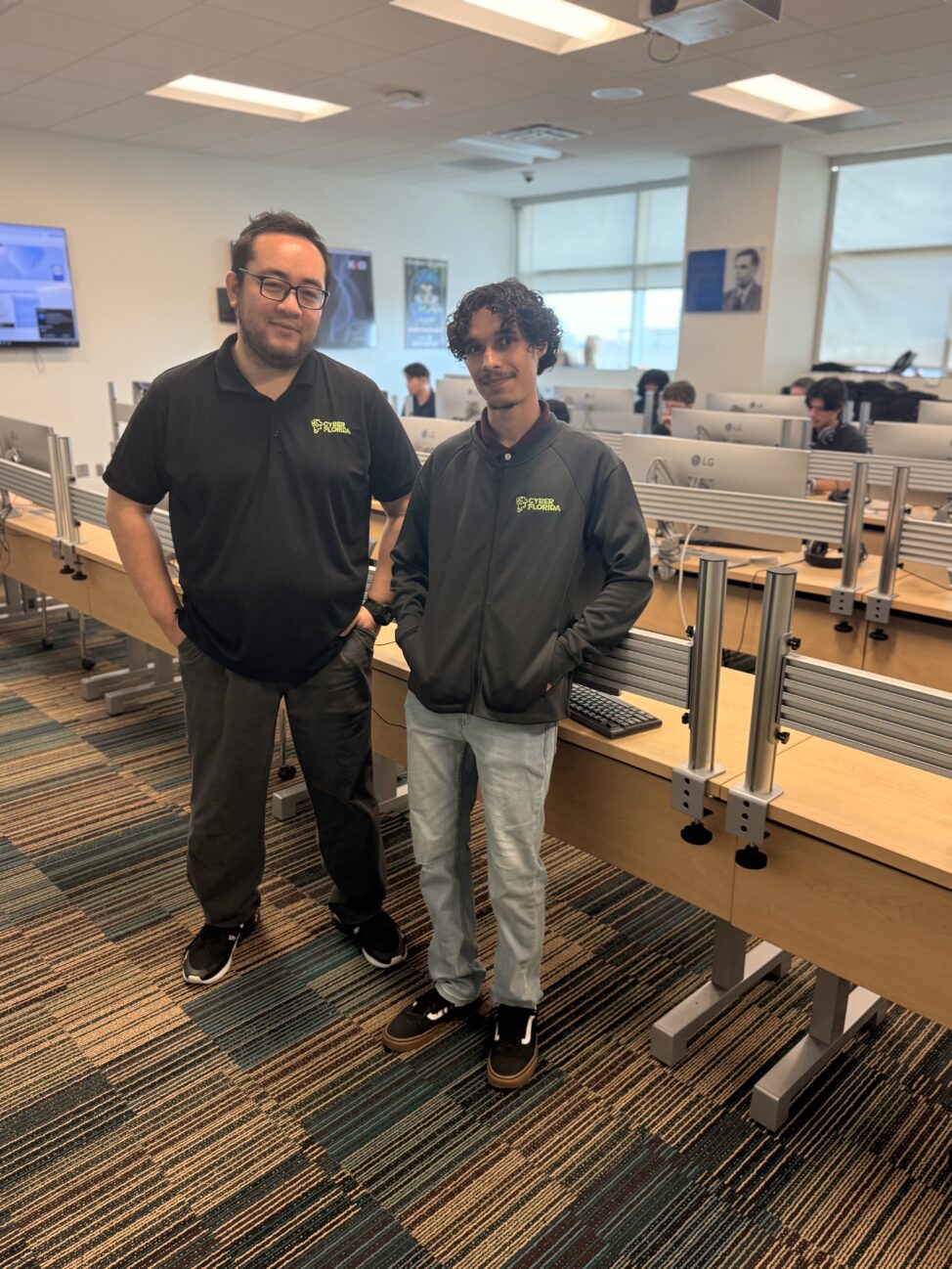
Assistant Security Operations Center Manager Duy Dao and new employee Issac Ward in the SOCAP classroom
Meet Isaac Ward
When Isaac Ward first started exploring the early internet and the history of computers in high school, he did not yet know it would lead him to a career in cybersecurity. But late-night dives into forums discussing cybercriminal groups, the dark web, malicious code, and major data breaches sparked something.
“I thought it was cool,” he says. “I liked the unknown and mysterious aspect.”
That curiosity eventually led him to study cybersecurity at the University of South Florida, drawn by both a full-ride scholarship and Tampa’s growing reputation as one of Florida’s largest cybersecurity hubs. Today, Isaac is bringing that same curiosity and drive to his new full-time role as a Cybersecurity Analyst in Cyber Florida’s Security Operations Center Apprentice Program (SOCAP).
Taking a Leap: Finding the Right Challenge
Near the end of his junior year at the University of South Florida, Isaac was already gaining hands-on experience in cybersecurity research while working at USF’s Institute of Applied Engineering (IAE). It was a strong opportunity he appreciated, but something was missing.
The institute had just begun building out a “cyber lab” initiative when Isaac arrived. While promising, it wasn’t yet the immersive, operational experience he was looking for. At the same time, he was balancing a heavy course load and side projects. Still, he felt the pull to push himself further.
“I needed more of a challenge and a more realistic experience of what I could expect in the field,” he explains.
During winter break, Isaac began searching for internships and part-time roles that would provide that real-world exposure. When he came across a job posting from Cyber Florida, he admits he didn’t check every qualification box.
“I remember meeting very few of the job requirements and just applying on a whim,” he says.
At the time, he knew little about Cyber Florida or SOCAP beyond having seen the organization mentioned on LinkedIn. But after being invited to interview, he dug deeper into the program and quickly realized it was exactly the kind of hands-on, operational environment he had been searching for.
The interview process itself stood out.
“It was a bit ‘different’ than normal interviews,” he says with a smile. “That’s a secret for future applicants. But it reflected the relaxed, casual work environment at Cyber Florida.”
In January 2025, Isaac officially joined the SOC as a student assistant, a decision that would ultimately shape the trajectory of his cybersecurity career.
Finding His Path to SOCAP
Like many students entering cybersecurity, Isaac knew the field was broad but wasn’t yet sure which direction to specialize in. After hearing about security operations centers while researching career paths, he decided to see firsthand what SOC work was really like.
As a SOC student analyst, he quickly discovered there was no such thing as a “typical day.”
“New alerts, incidents, news, and the freedom to choose what projects I wanted to pursue meant that there was no typical day in the SOC.”
That dynamic environment proved to be the right fit. When the opportunity arose to transition into a full-time role after graduating in December 2025, the decision was easy.
“SOCAP was not just a program to pick up new skills,” Isaac explains. “It was an information exchange, an environment where I could learn from different analysts’ thought processes, methods, and real-world knowledge.”
Making an Impact as a Student Analyst
During his time as a student analyst, Isaac made substantial contributions to SOCAP’s operations and threat intelligence efforts. He:
- Conducted incident response investigations in collaboration with the USF IT team
- Resolved more than 500 security alerts
- Developed automation tools to enhance SOC operations and cut response times
- Authored and published two Threat Advisories in Cyber Florida’s Threat Room
- Established the SOCAP Honeypot project to collect threat intelligence and analyze attacker behavior
For Isaac, publishing threat advisories and assisting with digital forensic investigations for clients, including USF, were particularly meaningful.
“Writing and publishing reports on current threats that others can read has a meaningful impact,” he says. “Working with USF IT to conduct investigations is fulfilling. I got to experience real incident response procedures while helping to strengthen the university’s security posture.”
Resolving hundreds of alerts also sharpened critical skills. Rather than seeing repeat alerts as “noise,” Isaac viewed them as opportunities to refine pattern recognition, distinguish anomalies from normal behavior, and improve workflow efficiency, foundational skills for any effective SOC analyst.
Building Threat Intelligence from the Ground Up
One of Isaac’s signature contributions was setting up SOCAP’s T-Pot Honeypot project.
Having previously experimented with honeypots, he saw an opportunity for Cyber Florida to collect its own threat intelligence, analyze attacker tactics, and potentially share insights with the broader security community. The volume of automated malicious traffic he observed was eye-opening.
“It surprised me just how much automated traffic is filtered out by network and email security tools behind the scenes. It showed that without strong filtering and access controls, an organization would succumb to bots and spam almost immediately.”
Through threat advisories and intelligence sharing, Isaac helped clients stay ahead of emerging threats by providing actionable indicators of compromise (IOCs) and clear vulnerability breakdowns, empowering organizations to build stronger detection and prevention rules.
Stepping Into Leadership
Now a full-time Cybersecurity Analyst employed by Cyber Florida, Isaac’s responsibilities have expanded. In addition to working with SIEM, DLP, IDP, EDR, and other security tools to detect and respond to threats, he also provides technical support, creates documentation, and contributes to ongoing investigations.
With that shift has come a new perspective.
“As a full-time employee, I feel more accountable in representing the SOCAP and acting as a leader for student apprentices. It has encouraged me to explore subjects beyond my comfort zone so I can broaden my knowledge and have more to share.”
Isaac particularly enjoys working with SIEMs and EDR platforms, such as Splunk, Microsoft Sentinel, SentinelOne Singularity, and CrowdStrike Falcon. Optimizing queries to surface high-value data efficiently is a challenge he genuinely enjoys.
“Tough investigations are fun,” he says. “When they’re too easy, I don’t feel like I’m growing. Difficulty isn’t an obstacle; it’s a challenge.”
Looking Ahead: AI and the Future of SOC Operations
Over the next year, Isaac is focused on expanding SOCAP’s threat intelligence capabilities and exploring the role of agentic AI in security operations.
He’s particularly interested in how AI can enhance SOC workflows, from automation and collaboration to improving report structure and efficiency. His goal is to continue publishing threat advisories, strengthen intelligence correlation using the T-Pot environment, and to help new student analysts develop their own methodologies.
For students aspiring to work in a SOC, his advice is clear:
“Learn how to automate or perfect your workflow through scripting, AI, or automation platforms. Balancing time and effort is key. Knowing when to dig deeper into an alert and when to recognize a false positive is a valuable, learned skill.”
From a high school student intrigued by the mystery of cyber threats to a full-time analyst strengthening Florida’s cybersecurity posture, Isaac Ward represents the power of hands-on experience, curiosity, and collaboration.
We’re proud to welcome him into this next chapter at Cyber Florida and excited to see the impact he’ll continue to make.