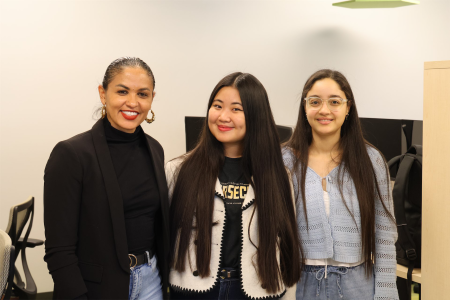
Dr. Michelle Angelo-Rocha with SOCAP students Waratchaya “June” Luangphairin and Lara Radovanovic
The Student Collaboration Behind Cyber Florida’s Multilingual Elder Fraud Guides
When Cyber Florida’s Security Operations Center Apprentice Program (SOCAP) student intern Waratchaya “June” Luangphairin helped co-author Protecting Against Elder Fraud and Scams in September 2025, she didn’t expect the guide to travel far beyond its initial audience. But just a few weeks after publication, a message landed in her LinkedIn inbox that would set off a wave of collaboration, translation, and community outreach—transforming a single cybersecurity awareness guide into a multilingual project serving Florida’s diverse communities.
Cyber Florida’s SOCAP provides paid internships that give USF students real-world cybersecurity experience. Interns learn to use state-of-the-art monitoring and threat detection tools while supporting public-sector organizations with supplemental cybersecurity services. As part of their work, students regularly publish threat advisories, guides, and scam alerts to help Floridians stay cyber safe.
June’s guide on elder fraud struck a chord—especially with one reader in Miami.
“After we published the cyber elder fraud report, I was contacted on LinkedIn by Marco Padilla, an IT infrastructure manager from Miami,” June explained. “He had shared the guide with his 83-year-old mother, reading it aloud to her since she doesn’t speak English. She found it so valuable that she asked, ‘Why don’t we distribute this to senior care facilities in Miami so more people can stay informed?’”
Marco offered to help translate the guide into Spanish, sparking an idea that grew into something much larger. June relayed his message to her SOCAP teammates and Cyber Florida leadership, and soon a small team formed to bring the vision to life.
Collaboration Across Languages
Working together, June, fellow SOCAP students Lara Radovanovic and Zahid Rahman, along with Cyber Research Analyst Dr. Michelle Angelo-Rocha, expanded the guide into Spanish, Portuguese, and Arabic, languages identified as among Florida’s most widely spoken.
Dr. Salwa Amer, head of USF’s Arabic language program, and Sanae Elmachour, a new SOCAP student, provided an additional review to confirm accuracy and readability of the Arabic translation.
Cyber Communications and Marketing Analyst Sarina Gandy managed the formatting and publication of all versions on the Cyber Florida website’s Threat Room.
Nearly 200 website downloads of the guide have been tracked.
Prior to the translation project, the English guide had been shared with organizations such as the Florida Health Care Association and LeadingAge Southeast to be distributed to their member organizations. Now, every version is freely available online, with audio narrations coming soon.
A Personal Connection to Purpose
“When Marco reached out to me, it caught me by surprise,” June said. “It was a genuine human connection between our technical work and the people it was meant to protect. I realized this is what it’s about—protecting people. Sharing this with my team inspired all of us. Ever since, we’ve been on the lookout for ways to go further—protect more people, in more mediums.”
The SOCAP team is now producing audio versions of each guide, with June reading the English version, Michelle narrating the Portuguese, and Lara and Zahid lending their voices to the Spanish and Arabic editions. Project manager Sarina expects the recordings to be uploaded by the end of 2025 on Cyber Florida’s YouTube channel, with links from the website.
And the work isn’t stopping there. The team has already begun plans for a Haitian Creole translation and hopes to bring the guides directly into the community through senior centers, churches, and programs that serve older adults.
“Collaborating with the students on this project was an excellent experience,” said Michelle. “We met regularly and worked together to ensure the guide in different languages was accurate, clear, and valuable for seniors whose first language is not English. The students fully led the project. I was truly impressed by the students’ initiative, professionalism, leadership, and dedication throughout the process. I am so proud of them!”
June concludes with these thoughts: “I would like to thank everyone for stepping in so quickly and without hesitation. Everyone immediately jumped in, and it made me feel supported, which is why I love working at CyberFlorida. Everybody here is excited and driven by the same purpose: spreading cybersecurity worldwide, starting in Florida.”
What started as one outreach report has evolved into a multilingual, accessible awareness project—proof that even a single message can spark meaningful change when driven by purpose and collaboration.