
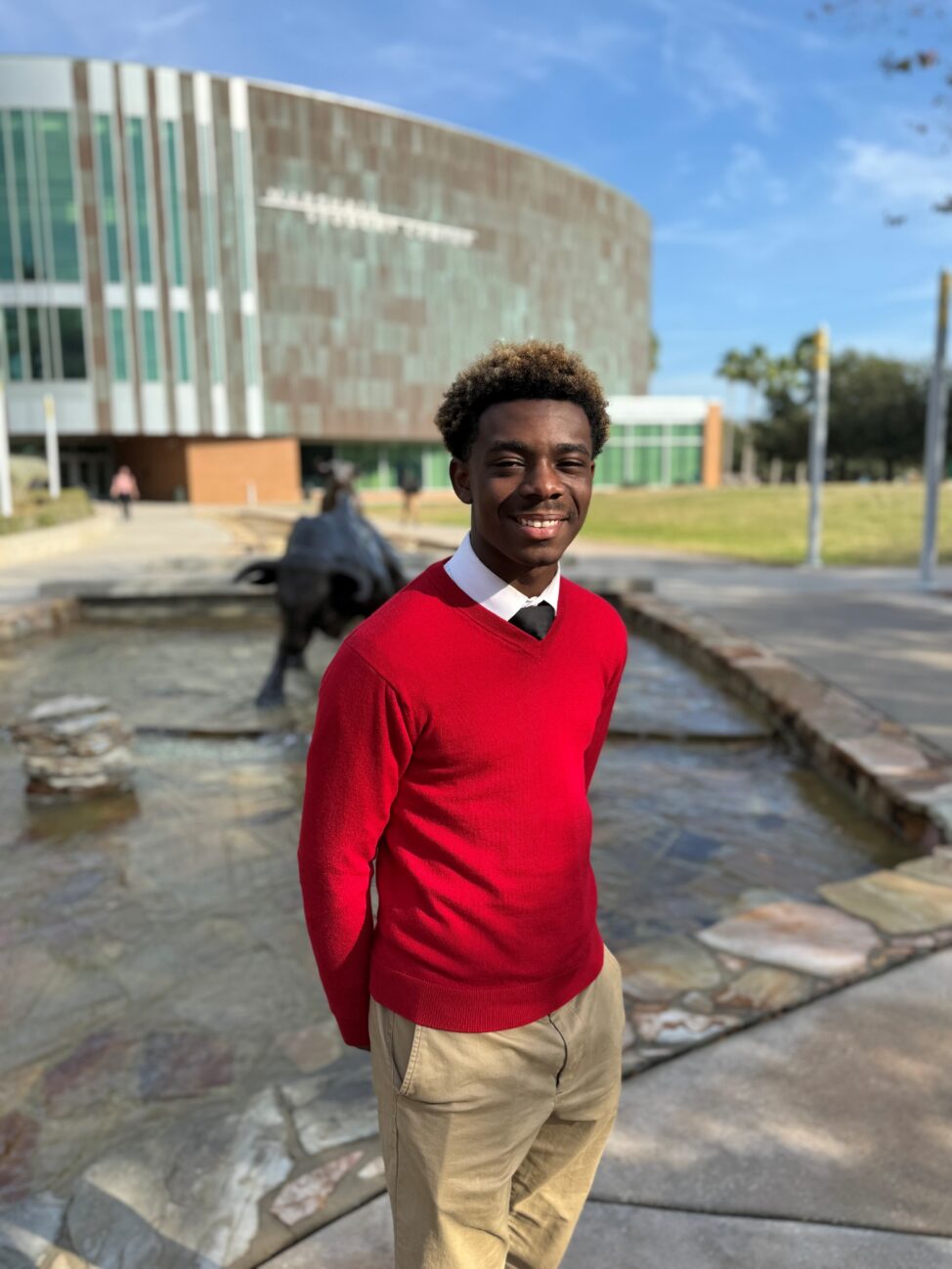
Alexavier Cherilus Is Just Getting Started
When you talk to Alexavier, one thing becomes clear almost immediately: he’s already thinking like a cybersecurity professional. The former George Jenkins High School (GJHS) cybersecurity academy student is now a freshman at the University of South Florida’s Bellini College of AI, Cybersecurity, and Computing. He has built an academic path defined by curiosity, initiative, and hands-on experience.
He’s earned industry certifications, completed a county-level cybersecurity internship, and is on track to graduate from USF a full year early, thanks to the dual enrollment classes he completed in high school. And he’s only just getting started.
Alexavier’s journey is a powerful example of how early exposure to cybersecurity, paired with the right mentors and opportunities, can set Florida students on a fast-moving trajectory toward meaningful careers in the cyber workforce.
Discovering a Passion for Cybersecurity
Alexavier has “always loved computers,” but cybersecurity didn’t emerge as a clear career path until high school, thanks, in part, to being in the right place at the right time.
He originally chose GJHS for its soccer program. During his junior year, however, the school launched Polk County’s first, and only, cybersecurity academy. At the time, Alexavier was enrolled in the digital design academy, where he helped create the cybersecurity academy’s first logo and pull-up banner. As the new program took shape, it quickly captured his attention.
A key influence in that transition was Austin Walley, the teacher selected by school leadership to establish the cybersecurity academy. Alexavier knew Mr. Walley from AP U.S. Government.
“Every time he would stop me before or after class, he’d show me new and exciting developments in technology or helpful gateway opportunities,” Alexavier recalls. That consistent encouragement made a lasting impression.
As the academy gained momentum and his interest deepened, Alexavier added the cybersecurity curriculum to his schedule. It was a pivotal decision—one that would define the rest of his high school experience and ultimately set the course for his future in cybersecurity.
Hands-On Learning at GJHS
Joining the academy in its inaugural year meant being part of something new, experimental, and ambitious. Alexavier dove in immediately.
By the time he graduated, he had earned two industry certifications:
- ITS Networking
- CompTIA Security+
He also competed in CyberPatriot, the national youth cybersecurity competition. “I’m most proud of my CyberPatriot placement during my first year,” he says. “With almost no prior experience, my group members and I were able to qualify for the state competitions in the silver league.”
One moment stands out from his academy experience: learning how quickly a brute-force attack can crack a simple four-digit password. “Less than a second,” he recalls. “I had no idea it was that easy.”
It was a memorable lesson, and one that changed his everyday habits. He now frequently reminds his friends and family to change passwords often, avoid reusing them, and assume that attackers can break weak patterns instantly.
What surprised him most, though, was how cybersecurity shows up in unexpected places.
“It’s everywhere, even in my psychology class,” he says. “Once you understand the concepts, you start seeing it all around you.”
Alexavier gravitates toward blue team work: defending systems, fortifying networks, and “being the shield.”
Real-World Experience: Polk County IT Internship
During his senior year of high school, Alexavier was selected, along with only three other cybersecurity academy students, for a competitive internship with Polk County’s IT department. The placement matched students with roles that aligned with their strengths and interests. Alexavier’s skills and work ethic made him an ideal fit.
He left school after sixth period, four days a week, to work two-hour shifts, gaining real SOC/NOC-style experience. His responsibilities included:
- Repairing and troubleshooting student laptops
- Operating and updating servers
- Learning the county’s ticketing system
- Fortifying machines and supporting network security hygiene
The hands-on exposure confirmed that cybersecurity wasn’t just something he enjoyed learning, it was something he wanted to do professionally.
College Life at USF’s Bellini College
Today, Alexavier is a freshman at USF, pursuing a cybersecurity degree with enough dual enrollment credits to potentially graduate a year early.
The transition hasn’t been without its challenges. “Learning to say no is a big hurdle,” he admits. “There are so many distractions.”
He has also had to “rewire” how he thinks to tackle coding assignments and higher-level coursework.
Still, he’s settling in well. He’s joined the Whitehatters Computer Security Club, where he’s learning “through osmosis” as he puts it, simply by being around other cyber-focused students.
He’s also joined a running club and has strong opinions about the best deal on campus: “Panda Express. A lot of food for ten dollars,” he says with a laugh.
One surprise about college-level cybersecurity, “There’s no standard starting point,” he explains. “Some people have barely touched a computer, and others have been coding since middle school.”
This dynamic both challenges and motivates him.
He’s currently exploring opportunities for a summer internship and plans to attend BSides Tampa 2026 to network and build connections that can open doors.
Looking Toward the Future
Alexavier’s long-term goals center on blue team cybersecurity—defending networks, managing security operations, and helping organizations stay protected.
He’s particularly fascinated by firewalls. “I want to learn not only how to properly secure them but also how red team individuals hack into them,” he says. “If I can understand both sides, I can defend better.”
This mindset—curious, proactive, and defense-oriented—makes him well-suited for SOC roles and other blue team pathways.
Advice for Cyber Curious Students
Alexavier’s advice to students thinking about pursuing cybersecurity is simple: “Pick up a computer and start learning.”
He credits much of his success to self-directed learning, watching YouTube videos, experimenting with tools, and exploring topics independently. “Don’t wait for someone else to teach you,” he says. “That’s what Mr. Walley taught me.”
His practical advice applies to everyone, not just future cyber pros:
- Change your passwords frequently
- Never reuse the same password
- Assume simple systems can be compromised in seconds
For students intimidated by coding, he offers reassurance, “Take it one step at a time. Start as basic as possible. Tackling everything at once is overwhelming. Break it down.”
He also shared a strategy that helps him stay motivated during difficult assignments: “When I get stuck, taking a break helps. I’ll step away, come back later, and nine times out of ten, solutions come easier.”
Student Pathways Lead to Workforce Development
What began as a move to join a high school soccer program evolved into a promising cybersecurity career trajectory for Alexavier. His story demonstrates how early exposure, supportive educators, structured programs, and real-world experience can transform student interest into tangible pathways.
Programs like the GJHS cybersecurity academy are building Florida’s future workforce one student at a time. And if Alexavier’s journey is any indication, the future looks bright!